
Whole Genome Sequencing (WGS): The Most Complete View of Your DNA
Whole Genome Sequencing (WGS) reads 100% of your DNA — all 3 billion base pairs — directly and completely. It's the most comprehensive genetic analysis available and a significant step beyond the standard DNA testing most people are familiar with.
How WGS Compares to Standard DNA Testing
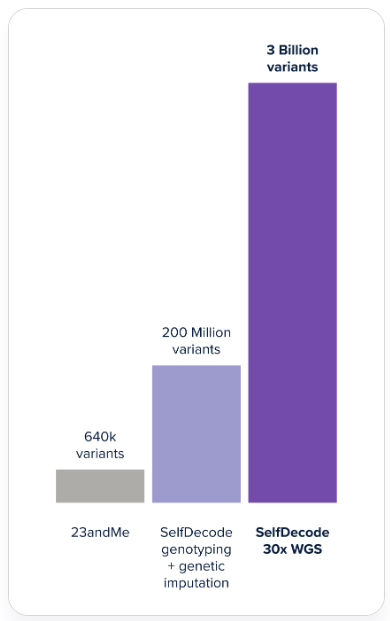
Standard DNA genotyping (the kind used in most consumer DNA tests) analyzes a small fraction of your genome and uses a technique called imputation to predict the rest. It works well for common health variants and lifestyle insights — but imputation is by definition a prediction, and it cannot detect rare variants or large structural changes in your DNA.
Standard Genotyping vs. WGS
WGS reads every base pair directly, with no prediction or inference. Here's how the two compare:
| Feature | Whole Genome Sequencing (30x) | Standard DNA Genotyping |
|---|---|---|
| DNA Coverage | 100% of genome (3B+ base pairs) | ~0.02% (~650K SNPs) |
| Rare Variants | Detects rare and novel variants | Misses most rare variants |
| Structural Variants | Detects insertions, deletions, CNVs | Cannot detect |
| Pharmacogenomics | Comprehensive drug response data | Limited panel |
| Future-Proof | Raw data reanalyzable as science advances | Limited to pre-selected markers |
| Accuracy (Read Depth) | 30x average coverage | Single read per variant |
We use Illumina Next-Generation Sequencing (NGS) technology.
What's Included
- 30x Whole Genome Sequencing (raw data) — Every base pair of your DNA is read an average of 30 times, generating a complete, permanent genomic dataset in standard VCF/BAM formats. Once you're sequenced, you never need to retest — new reports can be generated from the same data as science advances.
- Whole Genome Genius Report — A full WGS analysis identifying the most clinically relevant genetic variants, metabolic pathways, pharmacogenomic insights, and disease-risk signals across your entire genome. Translates complex genomics into actionable strategies for health optimization, longevity, precision medicine, and preventive care.
- Ultimate Rare Variant Screening — Identifies rare variants that are actually disrupting your biology, including variants conventional reports miss. Focuses on which rare variants have significant impact for you and what can be done about them.
- ACMG SF v3.3 Report — Screens for serious, medically actionable genetic risks based on the American College of Medical Genetics and Genomics Secondary Findings v3.3 guidelines. Covers inherited cancer, cardiovascular, and metabolic conditions. These findings are designed to guide real medical decisions, so we recommend reviewing them with your healthcare provider. [NEEDS CLARIFICATION: consumer-appropriate sample report link]
- Advanced Pharmacogenomics (PGx) Report — Maps your personal drug-response profile across hundreds of medications and supplements, using full genome data to accurately resolve complex structural variants in drug metabolism genes (such as CYP2D6) that standard testing routinely misses.
There are several report tiers available for existing members. For pricing, visit www.selfdecode.com/app/wgs or contact support@selfdecode.com.
Where WGS Makes the Biggest Difference
When a rare variant exists in your genome, standard genotyping often won't find it — not because it failed, but because it wasn't designed to look there. WGS has no blind spots. Key clinical areas where WGS stands out:
- Hereditary Cancer Risk — Full gene sequencing detects rare and novel variants in BRCA1/2, TP53, Lynch syndrome genes, and others that genotyping panels routinely miss.
- Pharmacogenomics — Accurately resolves complex structural variants in drug metabolism genes (e.g., CYP2D6) that are critical for safe medication dosing.
- Rare Variant Detection — The only method that reliably identifies low-frequency variants with outsized health impact.
- Cardiovascular & Inherited Cardiac Conditions — Identifies rare variants associated with cardiomyopathies, arrhythmia syndromes, and familial hypercholesterolemia.
- Neurological & Neurodegenerative Risk — Full coverage of genes such as LRRK2 and PSEN1/2, relevant to Alzheimer's, Parkinson's, and epilepsy.
- Structural Variants & CNVs — Detects large genomic rearrangements (deletions, duplications, inversions) implicated in cancer, immune dysfunction, and developmental conditions.
Is WGS Right for You?
WGS isn't necessary for everyone. It may be a strong fit if you:
- Have complex, unresolved health questions that standard genetic insights haven't answered
- Have a personal or family history of rare genetic conditions, hereditary cancers, or unusual responses to medications
- Are pursuing longevity or precision medicine and want the most complete genetic foundation available
- Have already done standard DNA testing and want to go deeper
- Want the highest possible confidence that nothing has been missed
For these situations, WGS is best thought of as the right starting point rather than an optional add-on. We recommend discussing your results with a healthcare provider — especially the medically actionable findings — so they can be interpreted in the context of your personal and family history.
Questions?
Email support@selfdecode.com.